
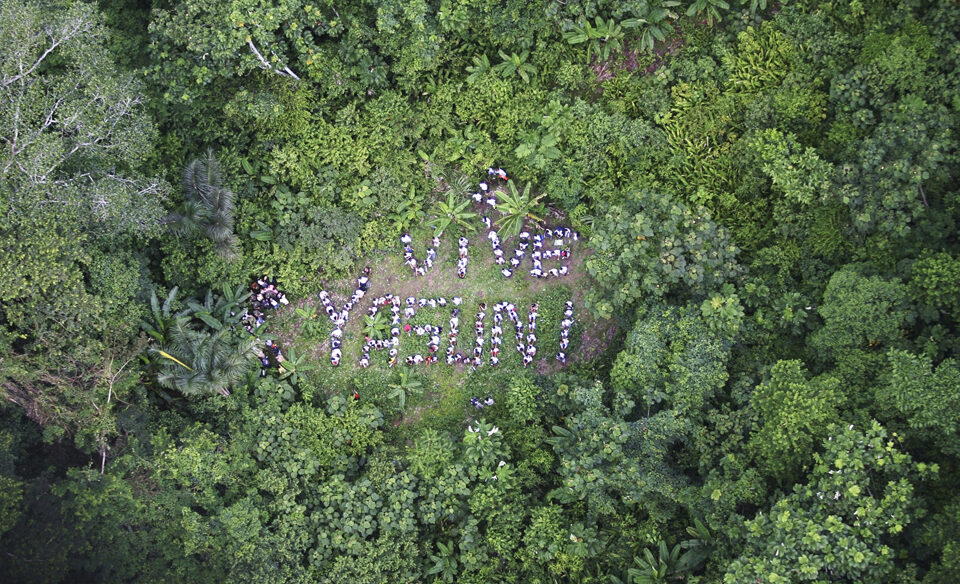
At Global Greengrants Fund, we have learned through decades of partnership with grassroots movements that the most important knowledge rarely fits neatly into predetermined frameworks. It lives in relationships, in memory, in cultural practice, and in deep, place-based understanding. Sometimes, it takes a different kind of map to make that visible.
In Ecuador’s Yasuní National Park, one of the most biodiverse places on Earth, our partners have been at the forefront of a profound reframing of what knowledge and impact truly mean. For years, the dominant maps of Yasuní told a one-sided story. They outlined oil blocks beneath the forest floor, charted potential extraction sites, and translated territory into economic value. These maps informed national development strategies and investment decisions. They were treated as objective, authoritative, and complete. But they did not show where jaguars drink water. They did not mark sacred sites. They did not trace the seasonal cycles of fruiting trees or the locations of medicinal plants. And critically, they did not include the Indigenous communities whose lives, governance systems, and cultural identities are inseparable from that land.
In response, Indigenous communities and civil society partners supported through Global Greengrants Fund advanced not only an alternative narrative, but an alternative infrastructure of knowledge.
Between 2019 and 2024, Global Greengrants funding enabled Colectivo Geografía Crítica del Ecuador to build a sustained, community-informed geographic monitoring system in and around Yasuní. This work combined satellite imagery, field inspections, citizen monitoring, and Indigenous territorial knowledge to document the expansion of oil infrastructure and its impacts across protected areas and Indigenous territories.
Through the creation of the GEO Observatory for the Yasuní, publicly accessible geoportals, and rigorous technical reports, the initiative transformed fragmented and often inaccessible state and corporate data into usable, verifiable evidence. It made visible what had long been obscured: the true scale of oil roads, drilling platforms, seismic activity, and the cumulative ecological footprint of extraction. These maps produced accountability.
Geographic evidence generated through this process was used in national legislative debates, judicial proceedings, and international human rights submissions. It helped demonstrate that oil operations were exceeding legal limits, threatening the Tagaeri–Taromenane Intangible Zone, and violating Indigenous rights. The semi-nomadic Tagaeri and Taromenane live in the Ecuadorian Amazon, including the Yasuní National Park. In 1999, Ecuador established the “Tagaeri Taromenane Intangible Zone,” a core area of the national park where all extractive activities are prohibited. A ten-kilometer buffer zone separates oil facilities and the no-go zone.
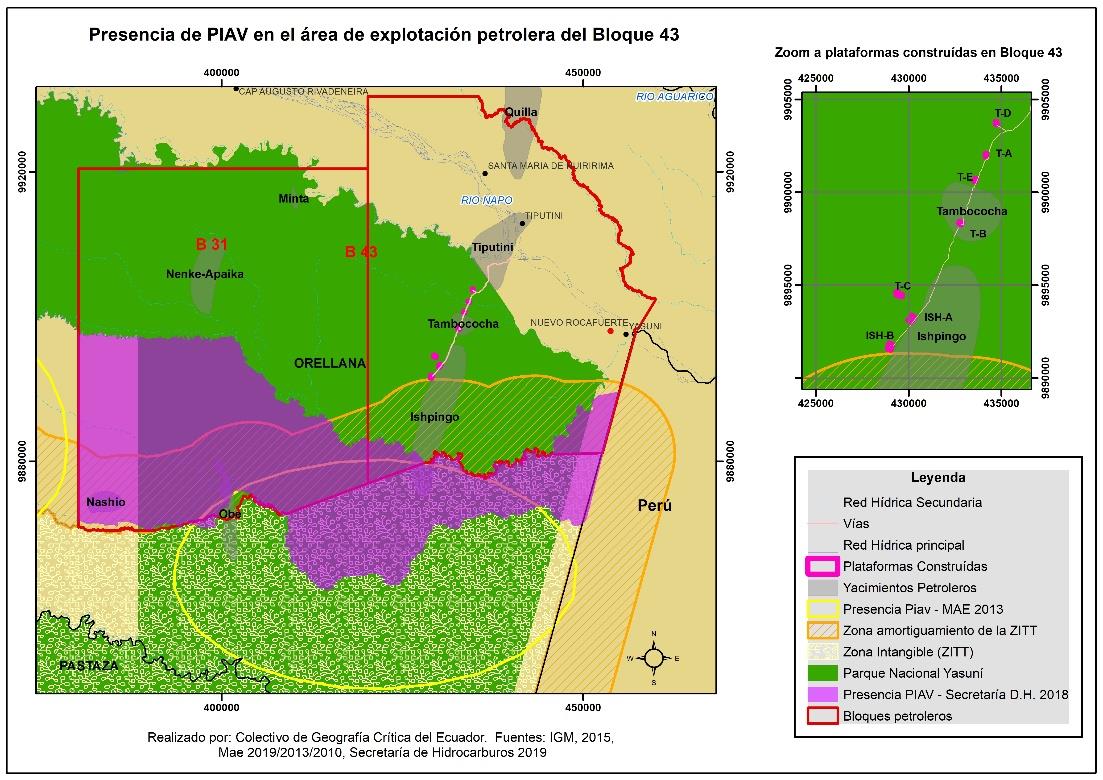
This collective mapping process helped catalyze one of the most significant climate and biodiversity decisions in recent history. In 2023, after years of coordinated territorial monitoring, legal advocacy, and public pressure supported by this evidence, a majority of Ecuadorians voted in a national referendum to leave oil in the ground in Yasuní. What made that outcome possible was the convergence of data, community leadership, and sustained relational infrastructure. The mapping process itself was deeply participatory. Indigenous authorities, women leaders, youth, scientists, and legal advocates worked together to gather evidence, interpret findings, and mobilize action. Community-based inspections documented lived impacts, from industrial noise traveling kilometers into forest communities to the failure of promised social protections. These new, highly collaborative maps connected lived experience to formal decision-making power, a connection conventional maps rarely achieve. They translated place-based knowledge into forms that could move courts, influence policy, and shape national discourse, without stripping that knowledge of its relational and cultural context, and they continue to do so.
Following the referendum, Global Greengrants-supported partners are now using the same tools to monitor whether oil infrastructure is actually being dismantled in accordance with the constitutional mandate. Satellite data, field verification, and public reporting are used to track compliance and ensure commitments are not merely symbolic but material and measurable on the ground. These efforts continue to unfold over time, across systems and through relationship. They are also a powerful illustration of what becomes possible when philanthropy invests in knowledge systems and the infrastructure that sustains them, year over year.
Reflecting on Philanthropic Ways of Knowing
Too often, impact assessment systems mirror the first map of Yasuní. They prioritize what can be measured quickly, aggregated easily, and compared across contexts. They seek clarity, standardization, and scale. But the Yasuní mapping process shows that some of the most consequential climate outcomes emerge from a different kind of reflection and investment. One that considers and supports:
- Independent, community-rooted monitoring systems that persist over years, not grant cycles
- The translation of lived experience into legal and political evidence
- The ability of frontline communities to engage directly with national and global decision-making processes
- The defense of territory as a foundation for climate stability and biodiversity protection
At Global Greengrants, this is the premise of our model. Through our decentralized advisory network and long-term partnerships, we invest in the relational and knowledge infrastructure that allows communities to define, defend, and advance their own visions of the future. The community-led advisory network strengthens our ability to be genuinely responsive—not just to trends or funding cycles, but to the actual needs and priorities of communities on the ground. Its members can identify emerging threats, recognize patterns across regions, and help us understand which relationships need to be protected and which ones need to be built. They help us ask better questions: not only “what is at risk?” but “what is already working, and how do we strengthen those connections?” In this way, the advisory boards sit at the center of our strategy, modeling the very kind of networked, relational approach that enables lasting change.
The story of Yasuní reminds us that knowledge is not neutral, and neither is resilience. Both are shaped by who is included, whose evidence is recognized, and what systems are built to carry that knowledge forward. Impact is not only what can be counted. It is what can be sustained, defended, and scaled through relationships over time. It is the ability of communities to generate their own evidence, shape national decisions, and hold institutions accountable long after a single grant has ended. It is the quiet but powerful work of building systems that make different futures possible. Because the most meaningful transformations rarely begin with an imposed understanding of place. They begin with a shift in how we see. And in philanthropy, supporting that shift may be one of the most strategic investments we can make.