
Co-written by Global Greengrants Fund and Grassroots International
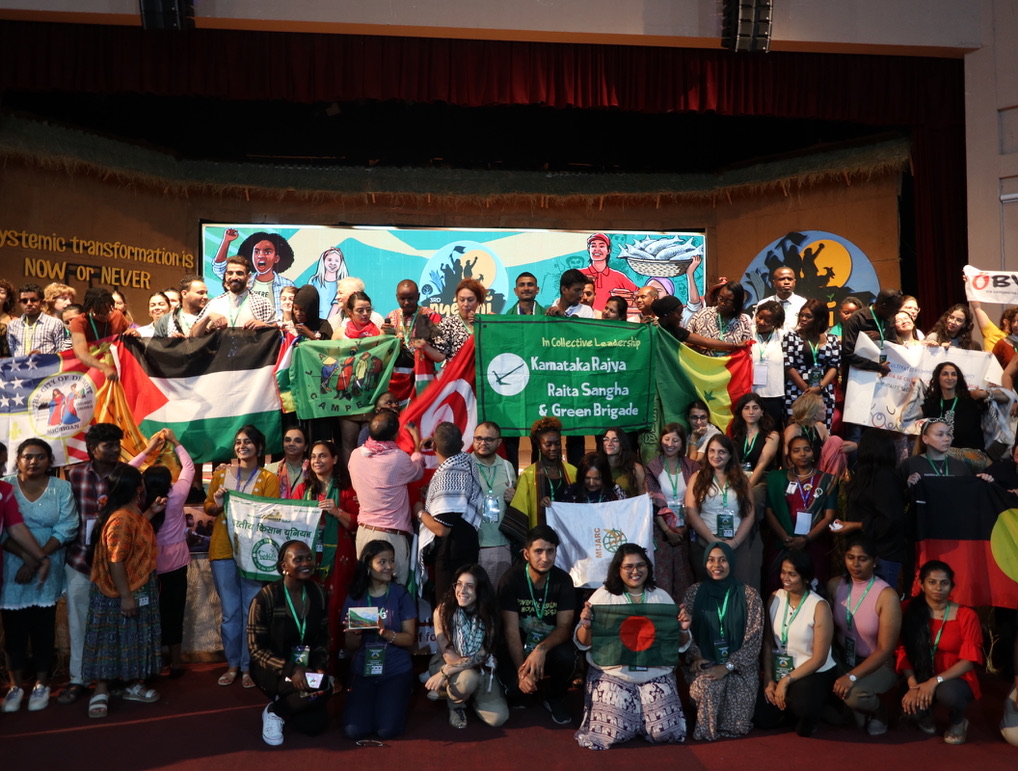
When hundreds of farmers, fishers, Indigenous leaders, feminists, and workers from 102 countries gathered in Kandy, Sri Lanka, in September 2025 for the Third Nyéléni Global Forum, they carried with them a powerful truth: that solutions to the intertwined crises of climate, hunger, and inequality already exist in the hands of those most affected. The Nyéléni Forum—born from decades of organizing by grassroots social movements—has long been the beating heart of the global food sovereignty movement. Its third convening, held last month, marked both a return to the roots of people-powered transformation and a bold step toward collective action for the years ahead.
As Global Greengrants Fund and Grassroots International, along with other funder partners, we were honored to accompany a diverse delegation of funders to Sri Lanka—the Nyéléni Funders Circle—to listen, learn, and stand in solidarity with the social movements shaping a just and regenerative future. What unfolded was more than a conference; it was an organizing moment of deep intersectional analysis, collective strategy, and political imagination. This was a historic moment, the first time in the 18 years of this process that a funder delegation has been invited into the forum.
A Living History of People’s Power
The Nyéléni process began more than two decades ago with the creation of the International Planning Committee for Food Sovereignty (IPC)—a space for social movements to intervene collectively in global policy debates. More than 6,000 organizations and 300+ million small-scale food producers self-organize through the IPC, which facilitates dialogue and debate around food security and nutrition among diverse actors. In 2007, the first International Forum on Food Sovereignty in Sélingué, Mali, gave the world its defining articulation of food sovereignty—in short, the right of peoples to define their own food and agriculture systems. Later, the 2015 International Forum on Agroecology affirmed agroecology as the pathway to achieving food sovereignty. The 2025 Forum in Sri Lanka built on that legacy, widening the circle to embrace climate justice, labor, feminist, Indigenous, and disability movements, among others, and to reaffirm food sovereignty as a cornerstone of systemic transformation. “These are not isolated events; they are organizing moments where social movements build power together,” said Saulo Araujo, Director of Global Philanthropy at Grassroots International, at our recent “Philanthropy Debrief: Reflections & Next Steps from the 3rd Nyéléni Global Forum.” Hosting the Forum in Sri Lanka carried special significance. As Anuka de Silva of the Movement for Land and Agrarian Reform (MONLAR) and La Via Campesina noted at the debrief, “After our people’s uprising for democracy in 2022, bringing Nyéléni here was a symbol of systemic change. This was the largest people’s gathering in Sri Lanka’s history—not organized by the state, but by movements believing they can change the system.”
The Forum came as Sri Lanka, like much of the Global South, faces a deep debt crisis and International Monetary Fund(IMF)-imposed austerity. In response, local movements are reclaiming cooperative institutions and rebuilding a people-centered economy.
Intersections of Struggle and Solidarity
The Forum wove together diverse struggles—Indigenous sovereignty, feminist economies, and food autonomy—into a shared political vision. Participants resisted the weaponization of food and health systems in war, opposed the corporate capture of oceans through the “blue economy,” and built an anti-debt movement rooted in food sovereignty and economic justice.
This intersectionality was not symbolic; it was embodied. Over 60 percent of the nearly 700 participants were women and gender-diverse people, with dedicated assemblies on feminism, youth, gender and sexual orientation diversity, and disability justice. As Vinita Sahasranaman of the Urgent Action Fund–Asia Pacific observed, “It was heartening to see a movement-centered space that forefronted feminist analysis. Food is a deeply feminist issue.” Interpreters provided translation in 18 languages, reflecting the Forum’s commitment to inclusion and language justice.
What emerged, Vinita said, was a clear affirmation: “Movements are the most impactful approach to securing environmental and climate justice.” From community-led seed banks to Indigenous trade frameworks, from women-led cooperatives to resistance against industrial aquaculture, the Forum showcased compelling alternatives to the capitalist, agro-industrial system—alternatives grounded in care, cooperation, and ancestral knowledge.
Philanthropy in True Solidarity
The recommendation for creating a space for dialogue with funders came from Nyéléni’s Resource Mobilization Working Group with the approval of the Nyéléni Global Steering Committee. The plan involved bringing allied funders into a funder-only space called the Nyéléni Funder Circle as the start of a collective process among people in philanthropy for mutual learning with social movements. The Nyéléni Funder Circle was formed in October 2024. For many in philanthropy, it offered a rare opportunity to practice deep listening and mutual accountability.“How does philanthropy stand in active, practical, and material solidarity with global social movements?” asked B de Gersigny, Vice President of External Relations at Global Greengrants Fund, at the recent debrief. “By standing in support of agendas created by movements themselves.”
Yet this alignment remains a work in progress. As Saulo reminded participants, it took three years to raise €2 million to fund the Forum—an indicator of how philanthropy often underestimates movement power. The goal of the Funders Circle, he explained, is to close that gap and co-create long-term strategies for sustaining global movements through a framework he described as solidarity philanthropy.
Philanthropy, in this vision, is not about control but accompaniment. Anna Lappé, Executive Director of the Global Alliance for the Future of Food, underscored this shift: “For funders who cannot directly support movements, there are many ways to enable environments where movements can thrive—legal protections, narrative power, and flexible funding.” She urged peers to provide unrestricted, long-term resources or to fund intermediaries such as Grassroots International, Global Greengrants Fund, Urgent Action Fund, and Thousand Currents that are already structured to move resources in ways aligned with movement priorities.
Building Power from the Local to the Global Stage
In Sri Lanka, participants reaffirmed that the Nyéléni process is an organizing arc rather than a one-off event: a living infrastructure through which grassroots movements coordinate strategy, amplify their demands, and advance systemic transformation across continents. As one participant put it, “We are not here to scale down, but to scale deep—to root solidarity in trust.” The upcoming People’s Summit at COP30 in Belém, Brazil, will carry forward key campaigns developed in Kandy—from debt justice and anti-privatization efforts, to the creation of a people-centered international trade framework rooted in food sovereignty. The same spirit of feminist leadership, South–South solidarity, and intersectional analysis that defined Nyéléni will guide this and future convenings. The movements that gathered in Kandy see COP30 not simply as a policy venue, but as another people’s space for convergence—a moment to bring food sovereignty, agroecology, and climate justice to the center of global climate debates.
These are not isolated gatherings; they are linked acts of movement choreography, shaping a collective political agenda that moves from the local to the global stage. Each forum builds the power, trust, and shared vision necessary to confront corporate capture, extractivism, and the weaponization of food and health. Together, they form a growing constellation of resistance and renewal—a people’s process for transforming the systems that shape life on Earth.
A Call to Action for Philanthropy
The lessons from Sri Lanka are clear: movements are not beneficiaries of philanthropy—they are the architects of just futures. To truly support them, funders must move from transactional grantmaking to transformational partnership.
That means:
- Investing in movement infrastructure, not just projects—supporting leadership, convening, translation, and political education.
- Practicing flexible, multi-year funding that honors movement autonomy.
- Accompanying with humility, recognizing that accountability flows both ways.
- Amplifying movement narratives in philanthropic spaces, shifting the story from charity to justice.
- Joining the Nyéléni Funders Circle, a collective space where funders commit to learning, alignment, and resourcing social movements directly.
The movements gathered in Sri Lanka reminded us that resilience is not built from boardrooms but from communities that feed, heal, and defend the planet. For philanthropy, the invitation is simple but profound: stand with movements—not above, not ahead, but alongside.