
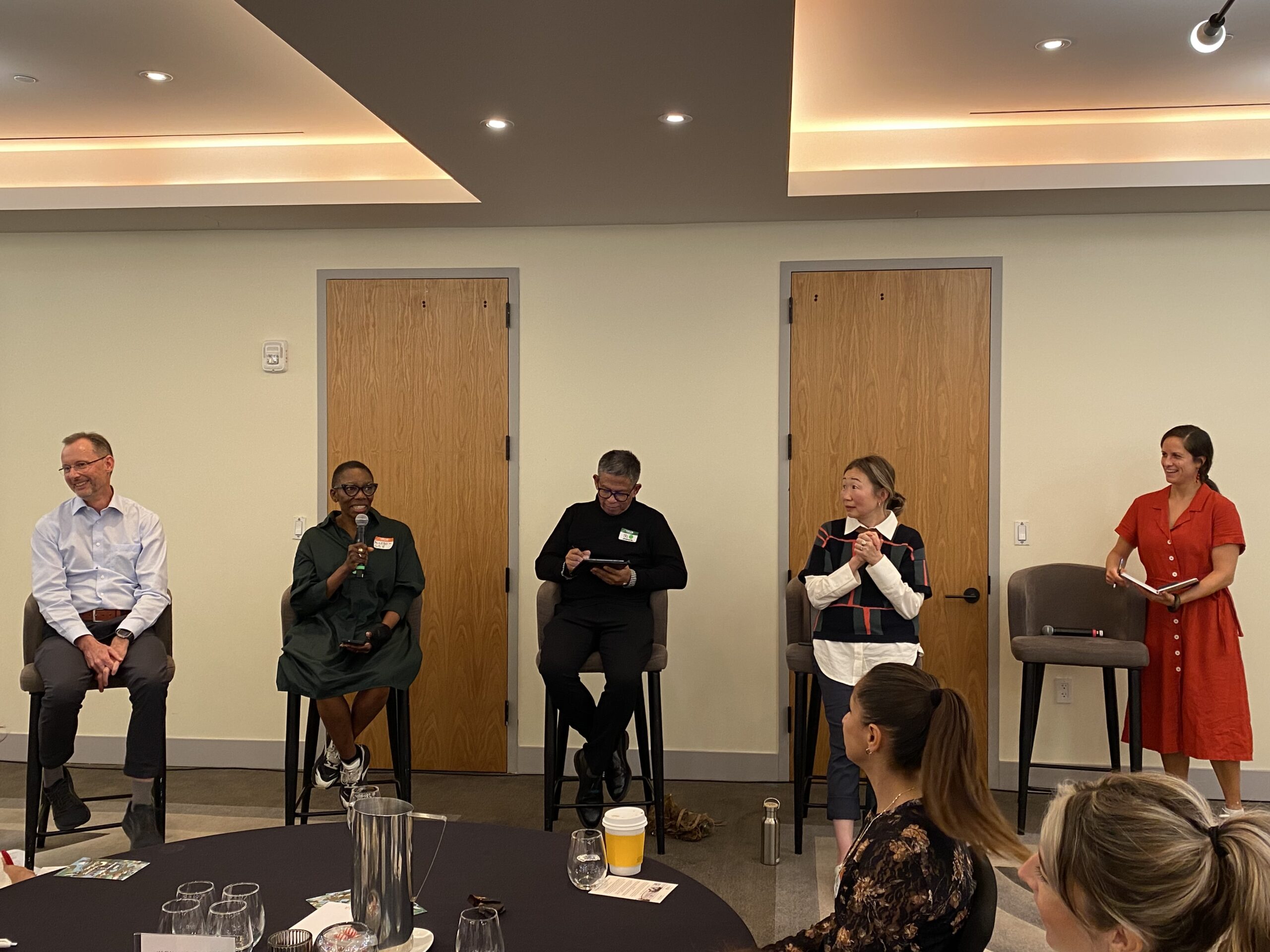
During Climate Week NYC 2026, Global Greengrants Fund and the David and Lucile Packard Foundation brought together Indigenous leaders, grassroots funders, conservation practitioners, and philanthropy to explore a fundamental question: What would conservation look like if human rights, community power, and locally led solutions were treated as essential to environmental success?
The conversation, Rethinking Conservation: Power, Rights and Locally Led Solutions, challenged approaches to conservation that separate people from nature and examined what it means for philanthropy to move beyond preventing harm toward actively shifting power to the Indigenous peoples and local communities who have stewarded lands, waters, forests, and biodiversity for generations.
Global Greengrants President and CEO Laura García opened the conversation by grounding rights-based conservation in both justice and effectiveness. Conservation models have displaced Indigenous peoples and local communities, criminalized traditional practices, and contributed to violence and other human rights abuses. Addressing those harms requires more than safeguards or better risk management, she argued. It requires questioning the systems of power that shape conservation itself.
“What made us think that the system that has caused the crisis is the right one to solve it?” — Laura García
For García, separating people from the planet is part of the problem. Philanthropy cannot stop at “do no harm.” Lasting climate and conservation outcomes require transforming who has power, whose knowledge is valued, and who gets to make decisions.
The panel brought together Galina Angarova, Executive Director of the SIRGE Coalition; Tri Nugroho, Co-Executive Director of the Samdhana Institute; Pontso Mafethe, Vice President of Programs at Global Greengrants Fund; and Nigel Sizer, Director of the Global Climate Initiative at the David and Lucile Packard Foundation, and was moderated by Holly Jonas of Mongabay.
People and nature cannot be separated
Angarova began from an Indigenous worldview that challenges the very categories often used by the conservation sector. In her native language, she explained, there are no direct words for “conservation,” “climate,” or “biodiversity.” Instead, these ideas are embedded within relationships among people, land, community, and the wider living world.
“Everything around you is you, and you are everything that’s around you.” — Galina Angarova
That understanding makes it difficult to isolate conservation from culture, spirituality, livelihoods, gender, rights, or sovereignty. When conservation projects are imposed from above—cordoning off land, displacing people, and eliminating livelihoods—the benevolent language of conservation can obscure the realities communities experience.
Recognition must extend beyond land tenure
Drawing on Samdhana Institute’s work in Indonesia and across Southeast Asia, Nugroho described community power as requiring many forms of recognition at once: territorial and legal recognition, certainly, but also cultural, political, scientific, economic, and international recognition.
Protecting territory can mean supporting community mapping and legal rights while also sustaining local languages, traditional knowledge, community economies, cultural practices, and communities’ ability to define their own futures. As Nugroho noted, the challenge is connecting these different forms of recognition rather than treating them as separate interventions.
His closing reflection sharpened that idea into an invitation for funders:
“Let’s fund the memory. Fund the intergenerational transfer of knowledge.” — Tri Nugroho
Gender justice is part of conservation infrastructure
Mafethe grounded the conversation in Global Greengrants’ own decentralized model, through which more than 250 locally rooted advisors help determine where resources and movement accompaniment are most needed. In the previous year alone, that network directed more than 2,000 community-level grants.
We know that women, girls, and gender-diverse people, especially Black, Afro-descendant, Indigenous, and rural, are already leading the most effective climate solutions: protecting forests, building food sovereignty, resisting extraction, driving community-led renewable energy, among others, and yet only ~5% of global human rights funding touches the gender/climate/environment intersection at all. For Global Greengrants, this means gender justice cannot be layered onto conservation after strategies have already been designed. 70% of what we fund aims to be women-led, and since around half of what we fund is biodiversity/conservation work, we fill a critical gap in the ecosystem by building gender justice into the model from the start, not as an afterthought or add-on.
“We see our role as filling a critical gap in the ecosystem by ensuring gender justice is built into our model from the get-go.” — Pontso Mafethe
Mafethe pointed to the recent struggle against seismic testing and oil exploration on South Africa’s Wild Coast as a powerful example of these connections: defending communities’ relationship with the sea simultaneously protects community rights and marine ecosystems.
Human rights are fundamental to conservation
Sizer situated rights-based conservation within the broader international human rights framework and reflected on experiences early in his career in the Brazilian Amazon, where communities were forcibly removed from protected areas in the name of conservation.
His experience illustrated both the human cost and the practical failure of fortress conservation. Communities that have lived with and stewarded ecosystems for generations cannot simply be treated as threats to biodiversity.
“There’s numerous peer-reviewed studies… that show over and over and over that [Indigenous peoples] do a better job—the outcomes are better in terms of conservation. That’s what the communities want to do, and that’s what we need to support them to do and partner with them to do.” — Nigel Sizer
That concern is particularly urgent in light of new evidence from Indigenous Peoples Rights International. Its five-year review of Indigenous-led documentation found that nearly one-third of the human rights violations in its database were linked to conservation, rising to around half when climate actions associated with critical-mineral mining and energy projects are included. The findings sharpen a central message from the discussion: conservation and climate action cannot deliver lasting environmental gains when they undermine Indigenous rights, self-determination, or Free, Prior and Informed Consent.
The discussion also underscored the importance of protecting civic space and environmental and human rights defenders. At a moment when civic space is contracting and Indigenous and environmental defenders face increasing criminalization, rights cannot be treated as a safeguard around conservation; they must shape how conservation is conceived, governed, and funded.
Moving from participation to power
As the conversation turned toward philanthropy itself, the speakers repeatedly returned to questions of who decides, whose knowledge counts, and where resources ultimately go.
Small, flexible grants, decentralized decision-making, long-term relationships, rapid response mechanisms, and investment in community institutions offer an alternative to funding systems that expect grassroots organizations to conform to structures designed far from the places where change is happening.
The conversation emphasized a powerful throughline: community-led conservation is among the most effective ways to protect ecosystems because it builds on the knowledge, governance, and stewardship already rooted in place.
In the closing reflections, Angarova made the case for moving beyond project-based funding altogether:
“Our work does not begin with a project proposal or end with a project report. It’s ongoing. This work is not a project for me. It’s my life.”
She also called for investment in a new generation of Indigenous leaders, recognizing that sustaining movements and territories requires transferring knowledge, leadership, and resources across generations.
Words—and inclusion—carry responsibility
In her closing reflection, Galina Angarova read a poem beginning with the words “Words carry meaning,” exploring community, intersectionality, lived experience, and what it truly means to include people whose lives are being discussed.
One passage cut directly to a tension familiar across philanthropy and international convenings:
“Do you give them the voice / Or do you give them a speaking slot / Do you allow them to change the course of the conversation?”
And later:
“Five minutes to summarize a lifetime. And then, thank you. Next speaker. That’s not inclusion.”
The poem closed by returning to responsibility: once we give words such as community and inclusion meaning, we also inherit a responsibility to live inside those meanings—to make them practices rather than aspirations. That idea captured much of what the conversation had surfaced.
What Community-Led Conservation Requires
This discussion continued the conversation Global Greengrants, Mongabay, and Blue Ventures had in July at London Climate Action Week. Reimagining Conservation Through Human Rights explored how conservation can move beyond historically exclusionary models and instead be grounded in Indigenous leadership, territorial rights, and community self-determination. The discussion underscored a growing recognition across the conservation sector: protecting biodiversity and protecting people are inseparable goals.
The evidence for community-led conservation is already strong. Territories governed by Indigenous Peoples and local communities consistently demonstrate lower rates of deforestation, greater biodiversity, more stored carbon, and greater ecological stability. The question for philanthropy is increasingly less about whether these approaches work and more about whether funding systems are willing to trust the people already doing this work.
For Global Greengrants, that means moving more funding directly to local communities and Indigenous Peoples—and making it long-term, flexible, and responsive enough for communities to determine the pace and direction of their work. Since 1999, conservation has been central to Global Greengrants’ grantmaking. Today, it represents roughly 55 percent of what GGF’s Advisory Boards recommend each year, contributing to nearly 3,900 conservation-related grants across 137 countries over the past decade. The work does not always unfold in a straight line. Relationships deepen, strategies evolve, political conditions change, and victories may take years. That is also how durable community ownership is built.
The results can be transformative. In Peru, Kukama leader Mari Luz Canaquiri Murayari—a 2025 Goldman Environmental Prize and a TIME 100 Most Influential People awardee in 2026—helped lead a landmark legal victory recognizing the Marañón River’s right to exist free from pollution and affirming the Kukama people as its guardians. It is one example of what becomes possible when communities can defend their territories through their own knowledge, leadership, and organizing.
As the global community looks toward its 2030 biodiversity and climate commitments, the challenge is therefore larger than moving more money. It is about who has the power to decide what conservation looks like in the first place. Indigenous Peoples and local communities have stewarded lands, waters, forests, and biodiversity for generations. If the goal is to protect the planet’s biodiversity for generations to come, they must be resourced not simply to participate in conservation, but to lead it.